Looking for glasses for optic nerve damage? That page is the glasses search; this one is the broader low-vision solution.
Aresearch studyconducted in Baltimore, United States, has shown that Optic Atrophy accounts for the prevalence of blindness in 0.8% of the population.
What if a low vision aid could help you make the most of your remaining sight and counter this vision loss?
IrisVision Vista is one such low vision solution.
It helps people with optic atrophy and optic nerve damage — along with many other visually impairing conditions — put their remaining vision to work.
To understand this better, let’s take a brief look at how optic nerve damage can affect eyesight, and how Vista helps fill that visual gap for a person.
Optic Atrophy vs. Optic Nerve Damage
The optic nerve extends from behind each eye towards the brain. It comprises ganglion cell bundles whose primary function is to transmit visual stimuli to the brain. The brain then decodes these neural messages and translates them into images that we can comprehend.
Damage to the optic nerve can occur because of various reasons, such as a congenital disease (e.g. Leber Hereditary Optic Neuropathy), an eye disease (such as Glaucoma, Optic Neuritis e.t.c.), or damage to the optic nerve anywhere along the pathway to the brain caused by brain trauma, tumor or inflammation. To learn more about conditions that lead to optic nerve damage, read here. The severity and nature of vision loss depend upon the cause of optic nerve damage.
Optic Nerve Atrophy is the most advanced stage of optic nerve damage, and it has a detrimental effect on a variety of visual capacities of a person, including peripheral vision, central vision, and color vision deficiency.
What Are The symptoms of Optic Nerve Damage & Optic Atrophy?

People may experience different symptoms in case of different root causes:
- Wide-angle glaucoma usually shows no symptoms, but a sudden loss of peripheral vision occurs.
- Narrow-angle glaucoma shows the following symptoms:
- Red eyes
- Pain in eye movement
- Headache
- Nausea/vomiting
- Symptoms of optic nerve head drusen may include:
- Central vision loss
- Dim vision
- Blind spots
- The following symptoms usually accompany optic nerve damage due to brain stroke:
- Memory loss
- Difficulty understanding speech
- Fatigue
- Dizziness
How Does Optic Nerve Damage Affect Vision?
Optic nerve damage and optic atrophy are more prevalent in older adults. It leads to the deterioration of multiple visual domains. Some of the common ways it affects vision are:

- Blurry vision
- Reduced sharpness and clarity of vision (visual acuity)
- Inability to see from the corner of the eye (reduced peripheral vision)
- Color vision deficiency
- Contrast sensitivity diminishes; a person may have difficulty in distinguishing written text from its background
- Poor constriction of the pupil
- Decreased brightness in either eye
Treatments for Optic Nerve Damage and Optic Atrophy
To treat optic nerve damage because of glaucoma, doctors usually recommend a combination of oral medication, eye drops, and microsurgery. These may sometimes have side effects. However, glaucoma is a lifelong condition that requires frequent follow-up and gradual vision loss over the years.
Timely treatment can halt optic nerve damage caused by inflammation, brain injury, or compression, but in most cases, it is difficult to restore the vision once lost.
You may wonder in today’s technologically and medically advanced world if there is anything that could light up the world again for a visually impaired person?
Yes. IrisVision Vista is exactly that device that can turn the world around for blind and visually impaired people. Now that you know, let’s dive straight into the details of how it can help.
IrisVision Vista: A Low Vision Solution for Optic Nerve Damage and Optic Atrophy
IrisVision Vista is a clinically validated assistive wearable device, developed in collaboration with researchers at Johns Hopkins University, Stanford, and UPMC Pittsburgh.
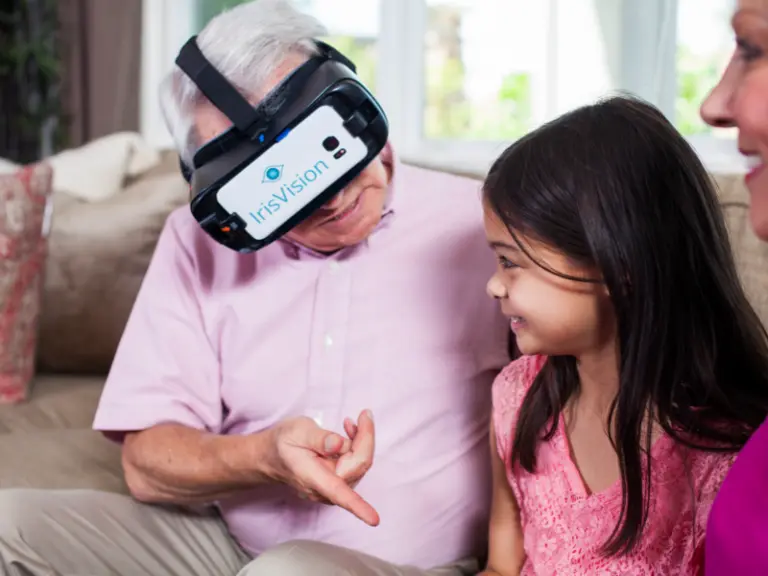
Vista is a wearable, hands-free low-vision headset with a high-definition camera and custom software that counters different low vision problems — magnification, contrast, and image clarity — all controlled by voice or a simple remote.
Given below are some of the modes and features of IrisVision Vista that can help you or a loved one.
Voice-first reading with “Iris” (OCR)
Given how Optic Atrophy affects a person’s ability to read, Vista makes reading effortless with its voice-first “Iris” assistant. From medicine prescriptions to cookbooks or a novel, you can read what you want with ease — just ask.
Using on-device Optical Character Recognition (OCR), Iris scans the page and reads the text aloud to you, hands-free. This relieves eye strain while still letting you take in written text without a problem.
Bubble View
While Vista helps scan and read out lengthy texts, it also lets you zoom in and magnify what you’re looking at. Bubble View magnifies a specific object or piece of text without losing the context of the wider scene around it.
For a person with low vision, this can be immensely helpful in reading road signs, warning labels, or locating an item on your kitchen shelf.
14x Magnification Power
Optic nerve damage diminishes the clarity of vision, making it exceedingly difficult for a person to recognize the things in front of them.
To cater to this, Vista comes with a vivid, high-definition view that lets you autofocus on a far-away object up to 14x its original size, all across a wide, natural field of view.
Reading Color Mode
Vista is designed so that it also helps people with optic nerve damage overcome poor color vision.
Most people with optic damage find it difficult to recognize and distinguish an object from its background because of reduced color differentiation, so Vista eases this by offering multiple contrast options. You can use a high color contrast or whichever setting suits you best for easy viewing.
Reading Line Mode
Reading Line Mode is one of Vista’s reading modes. It is specifically aimed at making it convenient to move through lengthy lines of written text, such as in a newspaper or a book.
It comprises a bar magnifier to comfortably view a segment of the lines.
Hands-free Entertainment
Everyone wants to unwind in their leisure time, and people with low vision are no exception — but it can be hard to enjoy a show when your sight gets in the way.
Vista lets you ask Iris to find and play YouTube videos full-size right inside the headset. Add the Vision Cast accessory and you can bring your TV and streaming services into Vista too, for a comfortable, hands-free pastime.
Voice-first “Iris” assistant
For a convenient, hands-free experience, Vista is built around its voice-first “Iris” assistant. Just speak, and Iris reads, zooms, and switches modes for you — in your own language, with no menus to learn.
Key Takeaway
Optic nerve damage is a painful eye condition to put up with for anyone, young or old. Its presenting symptoms and vision loss, both hinder even the basic daily routine activities of a person.
However, advanced low vision aids today can help achieve a better quality of life, even without a complete cure. Read a firsthand account of Ryan, who was diagnosed with a brain tumor at age 9 that cost him his vision — and how the IrisVision Vista low vision aid helped bring back his sight and his independence.
Low vision aids have helped thousands of people with Optic Atrophy live better lives every day, and you can also be one of them.