Searches for glasses for macular degeneration usually land on two shelves: drugstore optics, and wearable electronics. The American Academy of Ophthalmology writes about tints and high-add lenses. Amazon fills the rest with “AMD readers.” Neither shelf is the same as a camera-and-display headset.
This article explains the split, then where IrisVision Vista fits. It is not a diagnosis. Keep your retina specialist and a low-vision clinic in the loop.

What macular degeneration does to sight
Age-related macular degeneration (AMD) damages the macula — the central patch of retina you use for faces, print, and fine detail. Side vision often stays. That is why people say “I can walk around the house but I cannot read the mail.”
Dry AMD is more common and usually slower. Wet AMD can drop central vision quickly and is treated with injections, not glasses. The National Eye Institute’s overview is the right medical starting point; our age-related macular degeneration guide stays the long medical article.
Glasses cannot rebuild the macula. They can only help you use what remains.

Optical and filter glasses
Low-vision clinics and AAO materials describe:
- Updated refraction — still worth doing; AMD is not “just a stronger Rx,” but uncorrected blur stacks on top of retinal loss.
- High-add or prism readers — enlarge print at a short working distance.
- Yellow or amber tints, anti-glare, sunglasses — comfort in bright light; they do not restore letters.
- Absorptive filters (including some NoIR / FL-41-style products) — glare and contrast for some people. Not a headset.
If those options still leave you unable to recognize a face across the table, you have not “failed glasses.” You have reached the limit of lenses.
Wearable electronic Low Vision Glasses
Electronic glasses use a camera and a display. Software enlarges the live view, boosts contrast, or places a magnifying “bubble” on part of the scene. You look through remaining vision at a processed picture.
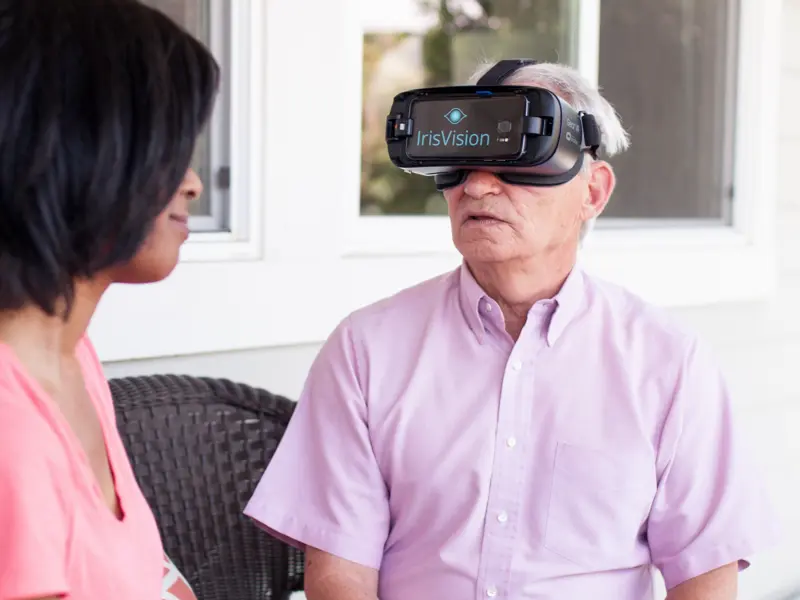
That is the category IrisVision Vista is in — wearable electronic Low Vision Glasses, not a $40 lens. The dedicated product page for this condition is macular degeneration glasses.
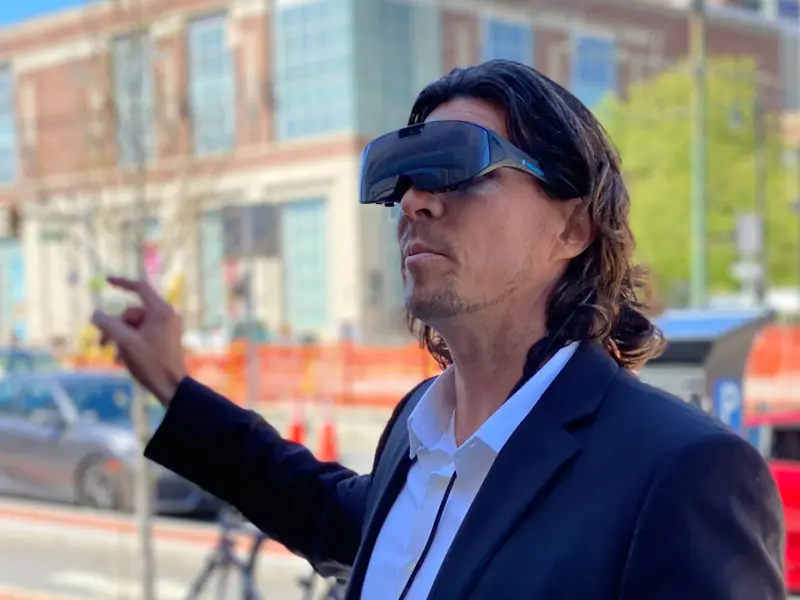
Vista is built for the tasks AMD takes first: mail, menus, faces, television, hobbies. Iris, the voice assistant, zooms and switches modes without a nest of menus. Personal coaching is included so you are not left alone with a new device.
It does not treat wet AMD. It does not stop dry AMD. It uses leftover sight.
Daily tasks with remaining central vision
Reading. High-contrast reading modes and line focus help when the page is still there but too small or too low-contrast. If the central scotoma is large, you may read with eccentric viewing — looking slightly off the word — which a clinic can teach.
Faces. A live magnified view is different from a photo. Lighting still matters.
Television. A headset that can hold a stable, enlarged image is why many families shop this category after “I can hear the show but not the faces.”
Walking. Enclosed headsets are for sitting and standing tasks more than sidewalk navigation. Do not wear Vista while walking or driving — the same rule as our user guide.
How this page relates to the rest of the site
| URL | Job |
|---|---|
| This article | What “AMD glasses” means (optical vs electronic) |
| Macular degeneration glasses | Condition product landing |
| AMD medical guide | Disease education |
| Smart glasses for the blind | Talking glasses versus an enhanced image |
| Vista | The product |
We do not merge those jobs. That is how we keep rankings on the medical guide while still answering the glasses query.
How to try a wearable aid
A low-vision clinic can measure remaining acuity, try lighting and high-add readers, and teach eccentric viewing. If those still leave mail and faces out of reach, a headset demo is the next step — not another yellow pair from Amazon.
Vista includes personal coaching so the first week is not guesswork. Take the suitability quiz, see Vista, or contact us. Bring your latest eye report if you can.
Frequently asked questions
Will new prescription glasses fix macular degeneration?
No. A refraction can clear focus error. It cannot replace damaged macular cells. If a new Rx barely helps, ask for a low-vision evaluation — not another pair of the same readers.
Are yellow glasses good for AMD?
Sometimes for glare. They are not “AMD treatment glasses.” If yellow lenses are the only result on page one, you are still in the optical aisle.
Are wearable electronic glasses the same as audio glasses?
No. Audio glasses describe a scene or read text aloud. They help when little usable sight remains. A headset such as Vista puts an enhanced picture in front of eyes that still see — zoom, contrast, reading and television modes, voice, and coaching. The difference is spelled out on smart glasses for the blind.
Where do I start if I am not sure?
Take the suitability quiz, see Vista, or contact us. Bring your latest eye report if you can.