Families search glasses for Stargardt disease after a teen or young adult is told “there is no cure, but we can try low-vision aids.” The next Google page is a mix of tinted sports glasses, high-add readers, and headsets. Those are not interchangeable.
This article is the glasses explainer. Medical background stays on Stargardt disease and is there any treatment. The condition product landing is Stargardt disease aid.
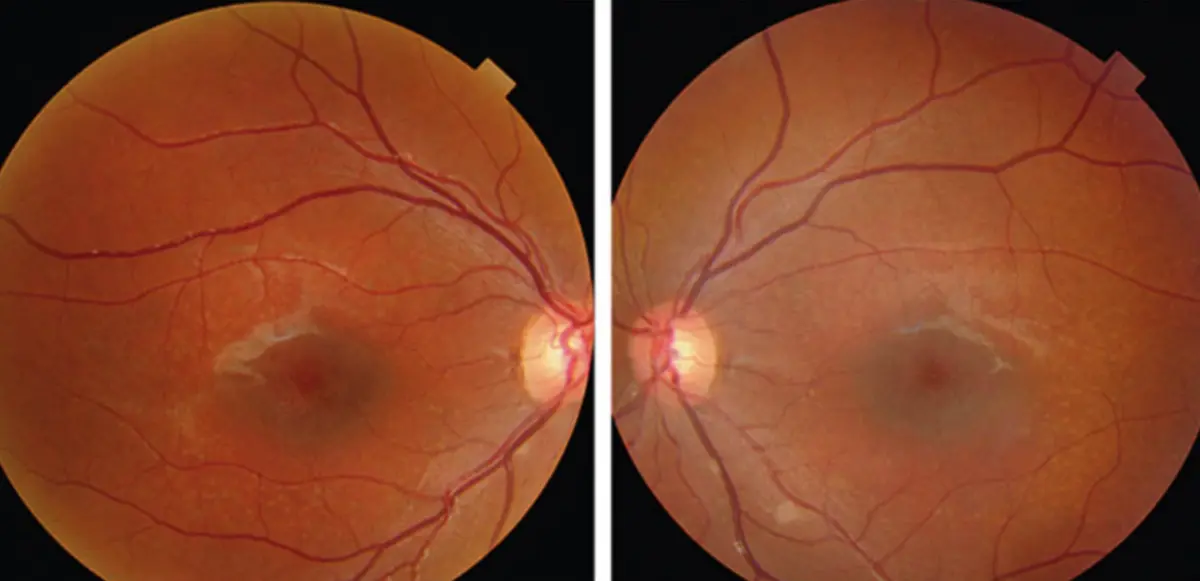
What Stargardt does to vision
Stargardt (often ABCA4-related) damages the macula earlier than typical age-related AMD. Central vision — the part used for print, faces, and screens — fades. Side vision is often better preserved. People describe a blur or gray patch in the middle with usable vision around it.
There is no pair of lenses that restores those cells. Gene and drug trials exist; they are not over-the-counter glasses. The National Eye Institute’s Stargardt page is the medical reference; we do not repeat it here.

Optical options clinics still try first
Low-vision specialists may prescribe:
- Updated glasses for any leftover refractive error.
- High-add or telescopic readers for short-distance print.
- Absorptive filters for photophobia — Stargardt and other macular conditions often come with light sensitivity.
- Task lighting and large-print / digital accommodations at school.
Those tools matter. They also have a ceiling. When a student can no longer keep up with a whiteboard or a 12-point handout, you have left the optical aisle.

Wearable electronic Low Vision Glasses
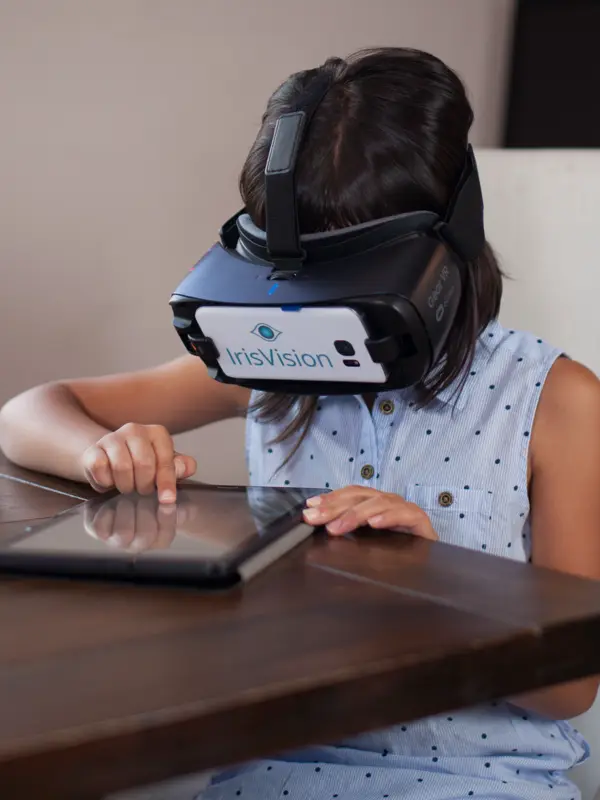
Electronic glasses put a camera and a display in front of remaining vision. Software enlarges the live scene, raises contrast, or isolates a line of text. That is the same family as IrisVision Vista — wearable electronic Low Vision Glasses, not a clip-on reader.
For Stargardt specifically, the useful jobs are:
- School and college — enlarging a board, a worksheet, or a laptop without sitting in the teacher’s lap.
- Work — email, spreadsheets, ID badges, and faces across a table.
- Independence — mail, menus, and hobbies that used to depend on central detail.
Vista’s Iris voice assistant changes zoom and modes without hunting through menus — useful when fine motor plus vision are both taxed. Coaching is included so the device is not left in a backpack.
It does not treat Stargardt. It uses leftover sight. Do not wear the headset while walking or driving; see the Vista user guide.
How this page relates to the rest of the site
| URL | Job |
|---|---|
| This article | What “Stargardt glasses” means |
| Stargardt disease aid | Condition product landing |
| Stargardt medical guide | Disease education |
| Treatment overview | Medical vs assistive |
| Smart glasses for low vision | Enhancement vs AI vs Meta |
| Vista | The product |
A redirect from the old /electronic-glasses-for-stargardt-disease/ URL points here so that historical phrase still lands on a 200 page.
How to try a wearable aid
A low-vision clinic can measure remaining acuity and field and try optical aids first. If those are not enough, a demo of a headset is the next honest step. Vista includes personal coaching so the first week is not “figure out the menus alone.”
Bring the latest retina notes if you have them. Ask about school accommodations (large print, extra time, a seat near the board) in parallel — a headset is not a substitute for an IEP or 504 plan.
Take the suitability quiz, see Vista, or contact us.
Frequently asked questions
Can regular glasses fix Stargardt disease?
No. A new prescription can clear focus error. It cannot replace macular cells lost to Stargardt. If stronger readers barely help, ask for a low-vision evaluation.
Are sunglasses enough for light sensitivity?
Filters and hats help comfort. They do not enlarge print. Many families use both — outdoor tints plus a headset for desk work.
Is Vista only for older adults with AMD?
No. Stargardt is often diagnosed in children and young adults. The hardware is the same family as AMD use; the tasks (school, first jobs) are different. See also glasses for macular degeneration.
Where should we start?
Take the suitability quiz, see Vista, or contact us. Bring the latest retina notes if you have them.